Via Mark Thompson's blog I have been alerted to this excellent examination of FPTP (first-past-the-post) by Prof John Curtice in Parliamentary Briefing.
John is the psephologist from Strathclyde University who in 2005 said the most likely result of the next election would be a hung parliament.
Basically, it is getting increasingly difficult to achieve one party rule under first-past-the-post for 3 main reasons - 1. the declining share of vote of the two main parties. 2. the dwindling number of marginals, and 3. the ineqitable treatment of the 2 main parties.
John's analysis sadly doesn't go on to analyse the boundary changes the Tories are planning. The enlargement of constituencies will make it less rewarding to vote other than the 'big two' but as John points out the main change is regional difference between North and South and this is virtually impossible for the Tories to gerrymander away.
A lot is made of the 'unfairness' to the Tories of 'only' winning 47% of the seats on 36% of the vote. Wrongly identified as the cause of this is that their constituencies have on average 4,000 more registered voters than Labour seats, but the clue there is in the word 'registered'.
When the lower registration of voters is taken into effect, Labour constituencies actually contain more potential voters and also have much more people because they have larger under 18 populations, not to mention higher workloads for MPs having to deal with the higher poverty and associated social problems.
The Tories with Lib Dem assistence are planning to make registration harder thus exarcerbating these problems and to ignore the fact that unregistered voters make Labour constituencies bigger. Lower turnout in poorer Labour seats is also the other reason why Labour can get less votes than the Tories and still not lose as many seats as Tories would on such a low national vote.
The real big problem for the Tories is the fact they cannot get more than 40% of the vote and most of that is concentrated in rural and suburban areas of England. In reality the Tories need to win some Billy Bragg types over to get large majorities, this seems unlikely to ever happen. We still remember the 80s.
The Tories want more marginals but seem unwilling to sacrifice some of their votes in their ultra-safe seats which is the only way of achieving this. It will also be interesting to see how they cull the number of MPs - Tories will want only non-Tory MPs culled - whether that is achievable I doubt.
I am going to be looking at each voting system in more detail over the next few months in the run up to the possible referendum. Starting soon with the glorious first-past-the-post system.
27 May 2010
25 May 2010
A Pound On A Packet Of Fags Would Sort The Deficit.
Chris Dillow points out that Osborne's cuts go against what the Tories election rhetoric promised. Here is my response to his post below.
Absolutely, these cuts are actually more regressive than I thought even the Tories at their worst would attempt - this is pure redistribution from poor to rich - the polar opposite of their social democratic rhetoric before the election - child trust funds and children's services abolished or slashed. With a choice between employee NI freeze or employers NI, the Tories revert to form in choosing the latter. There are no cuts to waste at all here, it is all front-line service cuts.
A pound on a packet of fags would sort the structural deficit of £40bn a year. I am not suggesting that smokers fund all the deficit gap, just give this as an example of how little tax increases would be needed if spread over a few areas. Instead, hundreds of thousands, perhaps millions are going to be put on the dole. How will this help the recovery?
£6bn of cuts may not be a lot on its own, but the public sector job losses will impact on the private sector as well and with the private sector not hiring, these unemployed could become another workless generation, just like the one created by the last Tory administration.
Absolutely, these cuts are actually more regressive than I thought even the Tories at their worst would attempt - this is pure redistribution from poor to rich - the polar opposite of their social democratic rhetoric before the election - child trust funds and children's services abolished or slashed. With a choice between employee NI freeze or employers NI, the Tories revert to form in choosing the latter. There are no cuts to waste at all here, it is all front-line service cuts.
A pound on a packet of fags would sort the structural deficit of £40bn a year. I am not suggesting that smokers fund all the deficit gap, just give this as an example of how little tax increases would be needed if spread over a few areas. Instead, hundreds of thousands, perhaps millions are going to be put on the dole. How will this help the recovery?
£6bn of cuts may not be a lot on its own, but the public sector job losses will impact on the private sector as well and with the private sector not hiring, these unemployed could become another workless generation, just like the one created by the last Tory administration.
17 May 2010
Take Back Parliament London Rally 15th May 2010
A video has been posted of the fair votes protest in London on Saturday. There were events around the country. Sadly I was working that day so couldn't join in.
14 May 2010
This 55% Red Herring Is A Storm In A Teacup
I think this is a storm in a teacup. In Scotland the super-majority is 66%. If you are serious about fixed term parliaments you have to have a super majority.
It still would only require a majority of parliament to change this rule back, it is not a democratic threat. This is all a bit of a red herring.
As it happens I have always thought the idea of fixed term parliaments (that loads of people were weirdly raving about before the election) a waste of time, because if the government of the day wants to find a way to call an early election they usually engineer a confidence vote and lose it. This has happened in Germany where they have fixed terms. There has to be this election escape clause otherwise you could end up with no government and years till an election.
I am beginning to think the Tory banckbenches are going to use this to scupper the coalition deal. We could be heading for another election within months unless the Lib Dems back down.
It still would only require a majority of parliament to change this rule back, it is not a democratic threat. This is all a bit of a red herring.
As it happens I have always thought the idea of fixed term parliaments (that loads of people were weirdly raving about before the election) a waste of time, because if the government of the day wants to find a way to call an early election they usually engineer a confidence vote and lose it. This has happened in Germany where they have fixed terms. There has to be this election escape clause otherwise you could end up with no government and years till an election.
I am beginning to think the Tory banckbenches are going to use this to scupper the coalition deal. We could be heading for another election within months unless the Lib Dems back down.
All Electoral Systems Are Rubbish: Discuss.
Tom Harris (Labour MP for ultra safe seat Glasgow South) has taken to defending first-past-the-post by admitting it is rubbish but that so are all other electoral systems.
While it is true that all electoral systems have defects, Tom is using the standard multinational/conglomerate method used by big oil, tobacco, food and pharmaceutical companies etc, of muddying the evidential waters which is known as 'manufacturing doubt'. Ben Goldacre talks about this in his book Bad Science in relation to the 'nutritional industry' and in relation to vitamin pill conglomerates.
The Tory press are adept at this, rather than analyse and discuss a study of say 50 countries that shows a comprehensive relationship between inequality, lower quality of life, higher government debt, less environmental protection, poorer value public services, higher corruption, lower political engagement and turnout with less proportional electoral systems, they will take one example, anecdote or even myth that suits their needs and claim that THAT proves their case.
This is exactly what Tom Harris is doing here. An example might be - 'Italy is corrupt and unstable and they have PR therefore all PR countries are corrupt and unstable'. This ignores the fact that the majority of countries with PR have much lower levels of corruption and instability than that seen in FPTP countries. It also plays on a few myths, for a start Italy has had a number of different electoral systems over the years, has actually had no more governments and elections than a lot of FPTP countries when you take 'cabinet reshuffles' into account probably less change at the top. And of course, Italy's problems relate more to its media and outside interference from the US to stop the communists gaining power in the 60s and 70s than it does to its electoral system.
You could also of course cite Israel or the Netherlands for instability, but that doesn't work quite so well for the FPTPers because Netherland in particular has a much stronger economy and society than ours and of course Israel has problems that would challenge any electoral system. But the fact remains, single cases and anecdotes are not enough to prove any case. Always be suspicious of people that do not engage with the evidence and just bang on about a single case as if their argument is self evident. It usually isn't.
It is hardly surprising that defenders of a system where the party with the most votes can get half the seats of the party that comes third, is having to admit it is rubbish. But to say this doesn't matter because other systems have faults is not enough. They should demonstrate WHY having slighter bigger constituencies is WORSE than this total disregard for how people vote. They should demonstrate how having more than 1 MP representing an area is WORSE than having many millions of people totally unrepresented in parliament. They should demonstrate why having 75% of seats so safe they never change and that a few party members behind closed doors really decide who is your MP is BETTER than an open list system where people can have a real choice of MP. They should demonstrate why having a system where the drawing of the boundaries has a bigger impact on results than how people actually vote is BETTER than having MPs elected by a majority that includes 2nd and 3rd preferences as well as 1st preferences.
And that is the crux of why first-past-the-post is the worst system - how much impact the boundaries have. It is not so much WHO you vote for that counts as WHERE you live and where the boundary quango decided to draw the boundaries.
This gerrymander wheel tool invented by the Australian proportional representation society shows how without any voter moving or changing their vote the result can be a narrow win for one side or a massive win for the other - just by moving the boundaries. And I am not talking about different size constituencies - every constituency remains the same size.
That is the crux of first-past-the-post, even if you are trying to be fair, the boundaries can throw up the most biased results. It doesn't have to be deliberate gerrymandering, under first-past-the-post it happens regularly by accident that the results are massively skewed against one party or other.
The Tories and Labour negotiated what they thought were fair boundaries between them (but not the other parties) in the 1990s and yet it resulted in a massive bias to Labour and not such a big bias towards the Tories (remember just because minor parties lost out more to Labour, doesn't mean that the bias was 'against' the Tories, just that the Tories didn't benefit as much in screwing the Lib Dems and others).
This is ultimately why the Tories agreed to a referendum on AV as long as the Lib Dems backed their changes to the boundaries - making constituency sizes bigger will help the Tories in a number of ways but it also increases the gerrymandering possibilities. And of course with the media on the Torie's side, a system that falls far short of being proportional and a Labour party in opposition that might also be hostile, the referendum is going to be difficult for the Lib Dems to win.
While it is true that all electoral systems have defects, Tom is using the standard multinational/conglomerate method used by big oil, tobacco, food and pharmaceutical companies etc, of muddying the evidential waters which is known as 'manufacturing doubt'. Ben Goldacre talks about this in his book Bad Science in relation to the 'nutritional industry' and in relation to vitamin pill conglomerates.
The Tory press are adept at this, rather than analyse and discuss a study of say 50 countries that shows a comprehensive relationship between inequality, lower quality of life, higher government debt, less environmental protection, poorer value public services, higher corruption, lower political engagement and turnout with less proportional electoral systems, they will take one example, anecdote or even myth that suits their needs and claim that THAT proves their case.
This is exactly what Tom Harris is doing here. An example might be - 'Italy is corrupt and unstable and they have PR therefore all PR countries are corrupt and unstable'. This ignores the fact that the majority of countries with PR have much lower levels of corruption and instability than that seen in FPTP countries. It also plays on a few myths, for a start Italy has had a number of different electoral systems over the years, has actually had no more governments and elections than a lot of FPTP countries when you take 'cabinet reshuffles' into account probably less change at the top. And of course, Italy's problems relate more to its media and outside interference from the US to stop the communists gaining power in the 60s and 70s than it does to its electoral system.
You could also of course cite Israel or the Netherlands for instability, but that doesn't work quite so well for the FPTPers because Netherland in particular has a much stronger economy and society than ours and of course Israel has problems that would challenge any electoral system. But the fact remains, single cases and anecdotes are not enough to prove any case. Always be suspicious of people that do not engage with the evidence and just bang on about a single case as if their argument is self evident. It usually isn't.
It is hardly surprising that defenders of a system where the party with the most votes can get half the seats of the party that comes third, is having to admit it is rubbish. But to say this doesn't matter because other systems have faults is not enough. They should demonstrate WHY having slighter bigger constituencies is WORSE than this total disregard for how people vote. They should demonstrate how having more than 1 MP representing an area is WORSE than having many millions of people totally unrepresented in parliament. They should demonstrate why having 75% of seats so safe they never change and that a few party members behind closed doors really decide who is your MP is BETTER than an open list system where people can have a real choice of MP. They should demonstrate why having a system where the drawing of the boundaries has a bigger impact on results than how people actually vote is BETTER than having MPs elected by a majority that includes 2nd and 3rd preferences as well as 1st preferences.
And that is the crux of why first-past-the-post is the worst system - how much impact the boundaries have. It is not so much WHO you vote for that counts as WHERE you live and where the boundary quango decided to draw the boundaries.
This gerrymander wheel tool invented by the Australian proportional representation society shows how without any voter moving or changing their vote the result can be a narrow win for one side or a massive win for the other - just by moving the boundaries. And I am not talking about different size constituencies - every constituency remains the same size.
That is the crux of first-past-the-post, even if you are trying to be fair, the boundaries can throw up the most biased results. It doesn't have to be deliberate gerrymandering, under first-past-the-post it happens regularly by accident that the results are massively skewed against one party or other.
The Tories and Labour negotiated what they thought were fair boundaries between them (but not the other parties) in the 1990s and yet it resulted in a massive bias to Labour and not such a big bias towards the Tories (remember just because minor parties lost out more to Labour, doesn't mean that the bias was 'against' the Tories, just that the Tories didn't benefit as much in screwing the Lib Dems and others).
This is ultimately why the Tories agreed to a referendum on AV as long as the Lib Dems backed their changes to the boundaries - making constituency sizes bigger will help the Tories in a number of ways but it also increases the gerrymandering possibilities. And of course with the media on the Torie's side, a system that falls far short of being proportional and a Labour party in opposition that might also be hostile, the referendum is going to be difficult for the Lib Dems to win.
13 May 2010
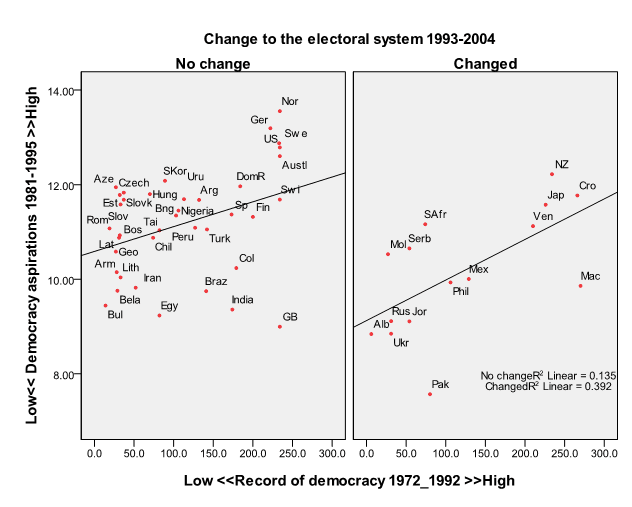
Pippa Norris - Excellent Take On Electoral Reform
Here is a great scatter graph on the relationship between democracy and electoral systems. Pippa also explains why electoral change can occur.
As she explains, it is a shame that the referendum in the UK doesn't ask if people want reform and then put forward a range of options rather than just offering the one system. But when it comes to the Tories, beggars cannot be choosers, this is about as most as we could have possibly hoped for coming from them. I highly recommend Pippa's blog.
What Is Cameron's Plan?
I think that Cameron has three main objectives in his Con-Dem coalition.
1. Labour can still be blamed in the early years for the depression that is coming - the high unemployment and pay freezes.
2. The Lib Dems will help win support for the intense privatisation and tax rises that is to come and take some of the blame for its failures.
3. Win or Lose the AV referendum, Cameron will get his larger constituencies. These boundary changes will make more difference in seats than any movement in their share of vote - which could actually grow now the Lib Dems will be tainted by unpopular policies and the Tories helped to seem more human by being associated with the Clegg and co. De-toxify the Tory brand - Cameron will have achieved his aim.
The question is; Is Cameron happy that the raving right of his party is balanced by some Lib dems on the left? I am not so sure Cameron was the moderate he claimed. But he certainly is putting on a good act. We shall have to see if my cynicism is correct.
1. Labour can still be blamed in the early years for the depression that is coming - the high unemployment and pay freezes.
2. The Lib Dems will help win support for the intense privatisation and tax rises that is to come and take some of the blame for its failures.
3. Win or Lose the AV referendum, Cameron will get his larger constituencies. These boundary changes will make more difference in seats than any movement in their share of vote - which could actually grow now the Lib Dems will be tainted by unpopular policies and the Tories helped to seem more human by being associated with the Clegg and co. De-toxify the Tory brand - Cameron will have achieved his aim.
The question is; Is Cameron happy that the raving right of his party is balanced by some Lib dems on the left? I am not so sure Cameron was the moderate he claimed. But he certainly is putting on a good act. We shall have to see if my cynicism is correct.
Will Labour Campaign For AV: Response To Mark Thompson
I think it all depends on which leader they get. As far as I know, of the potential candidates only Jon Cruddas would support electoral reform. And he is unlikely to win.
Ed Balls and Ed Miliband are definitely against change, and I imagine David Miliband is too. I suspect Alistair Darling is against as well. I imagine Labour will largely campaign against despite their AV pledge in the manifesto, with a number of notables campaigning for - such as Alan Johnson and Peter Hain.
I think Labour's position on this will also depend on what is planned for constituency boundaries. On the present boundaries which are likely to be changed before the next election, Labour would do well out of AV, with the Tories doing worse. With boundary enlargement I suspect the Tories might pick up 2nd preferences from more rural Lib Dems and do much better.
Ed Balls and Ed Miliband are definitely against change, and I imagine David Miliband is too. I suspect Alistair Darling is against as well. I imagine Labour will largely campaign against despite their AV pledge in the manifesto, with a number of notables campaigning for - such as Alan Johnson and Peter Hain.
I think Labour's position on this will also depend on what is planned for constituency boundaries. On the present boundaries which are likely to be changed before the next election, Labour would do well out of AV, with the Tories doing worse. With boundary enlargement I suspect the Tories might pick up 2nd preferences from more rural Lib Dems and do much better.
Why FPTP Stinks, Another Reply To Tom Harris
Tom, your seat is so safe it is bad for democracy. I'm sure you don't think your seat is safe because of you, do you? You and I both know that anyone could win that seat for Labour unless they were a mass murderer or something (even then they might hold on). Don't you think it funny that the biggest defenders of FPTP tend to come from seats like yours?
Anyway, what do you think of the graph showing a correlation between the seats the largest party wins and higher government debt? Also the Harvard study showing that PR run countries are more equal (which in turn means less crime, less social problems, better environment and a better quality of life). Basically FPTP produces higher government debt and more inequality, lower turnout and lower political engagement, worse public services and higher corruption. Nobody should defend this, especially those supposedly on the left.
Unemployment to hit 4m in next 3 years.
A lot of people in the public sector are currently panicking about losing their jobs, or almost as bad, being 'privatised' with the accompanying lowering of pay and conditions.
This will not only puts hundreds of thousands of public sector workers on the dole, it will hit private business as well.
I expect unemployment to soar. Labour would have made their cuts more gradually and the pain would have been shared more equally with higher growth and tax rises taking up some of the pain. The Con Dems have to make their cuts quick and hope for recovery by the election in 2015 (if they last that long). They have agreed to cut the deficit with spending cuts rather than tax rises. We shall see what happens. The last Laboiur government was in fact the most successful government at cuttin the deficit. It rose under Thatcher. People confuse tax cuts for the rich with cutting the deficit. All Thatcher managed to do was use the revenue from North Sea Oil and Public sell offs to fund the inequality gap - cutting taxes for the rich and benefits and wages for the poor. I expect the Con Dems will do pretty much the same. Although I am hopeful the Lib Dems will moderate it a bit.
This is going to hurt a lot
This will not only puts hundreds of thousands of public sector workers on the dole, it will hit private business as well.
I expect unemployment to soar. Labour would have made their cuts more gradually and the pain would have been shared more equally with higher growth and tax rises taking up some of the pain. The Con Dems have to make their cuts quick and hope for recovery by the election in 2015 (if they last that long). They have agreed to cut the deficit with spending cuts rather than tax rises. We shall see what happens. The last Laboiur government was in fact the most successful government at cuttin the deficit. It rose under Thatcher. People confuse tax cuts for the rich with cutting the deficit. All Thatcher managed to do was use the revenue from North Sea Oil and Public sell offs to fund the inequality gap - cutting taxes for the rich and benefits and wages for the poor. I expect the Con Dems will do pretty much the same. Although I am hopeful the Lib Dems will moderate it a bit.
This is going to hurt a lot
ID Cards & ID register ConDem'd. NO2ID rejoice.
I don't think this will make a blind bit of difference to our civil liberties. It will save some money theoretically but in practise not much, as a lot of money has already been spent, or will be spent in closing it down.
I also think even the ConDem government will embrace new technology in the end. CCTV has had an impact on crime, people are being caught because of it, ditto the DNA database which has not only captured criminals who would never have been caught but actually enhanced our liberties by proving innocence of those already convicted or accused of crimes.
A lot of NO2ID propaganda is about technophobia, not all of it, but a lot. There is far more surveillance by the private sector than by the government. Somehow this is strangely more accepted by NO2ID and the general population. Perhaps its the fact the Tory fanzine press are obsessed with anything negative about a government when their people don't control it and the private companies spend billions to tell us how nice they are in the same Tory press, which buys the media silence.
I also think even the ConDem government will embrace new technology in the end. CCTV has had an impact on crime, people are being caught because of it, ditto the DNA database which has not only captured criminals who would never have been caught but actually enhanced our liberties by proving innocence of those already convicted or accused of crimes.
A lot of NO2ID propaganda is about technophobia, not all of it, but a lot. There is far more surveillance by the private sector than by the government. Somehow this is strangely more accepted by NO2ID and the general population. Perhaps its the fact the Tory fanzine press are obsessed with anything negative about a government when their people don't control it and the private companies spend billions to tell us how nice they are in the same Tory press, which buys the media silence.
Who to choose for Labour leader?
Ed Balls would be a disaster, so would David Miliband. How do I know? Well I predicted Brown would lose us votes even before he became PM. Image matters whether we like it not. Balls is fat and comes across as pompous.
I would pick the best looking person with good communication skills - which, of the limited choices available, leaves Jon Cruddas and Ed Miliband. I am on the left, so Jon would be my choice.
Sadly Labour members are likely to choose neither because the party has become so hollowed out only neanderthal tribalists, charlatans and nerds are left in the party. And none of these have got a clue about public opinion.
I would pick the best looking person with good communication skills - which, of the limited choices available, leaves Jon Cruddas and Ed Miliband. I am on the left, so Jon would be my choice.
Sadly Labour members are likely to choose neither because the party has become so hollowed out only neanderthal tribalists, charlatans and nerds are left in the party. And none of these have got a clue about public opinion.
Why Constituency Boundaries Are As Important As Electoral Reform
This is in reply to this excellent post here by peezedtee.
PZT: Very good post. It seems incredible today to think Tories were so pro-PR in the 70s, there are virtually none today.
Kellner's anaylsis is good, there are two problems with FPTP for the Tories.
The first is the minor problem of surburban drift where Tory constituency size grows between boundary reviews. Tory constituencies tend to have a few thousand extra constituents. A big thing is made of this and 'equalising constituencies' by the Tories, as if this will solve their problem but in fact it will make less than half a dozen seats difference to the result (as demonstrated by the recent big boundary changes in their favour which only garnered them 10 or so seats).
The second and much bigger problem for the Tories is the concentration of their vote in the South of England, and in suburban and rural areas.
They plan to address this by increasing the constituency size under the populist guise of 'reducing the cost of politics', i.e. cutting the number of MPs. They propose a 10% reduction from 650 to 585. This will help them in the short term, well at least to some extent, because the massive change in boundaries this will require will obliterate any current personal votes and make it much more difficult for smaller parties to establish themselves. The rise of the Greens in Brighton shows how under the current size it is still possible for small national parties to reach out and knock on doors. The loss by the excellent independent Dr Taylor in Wyre Forest shows it is still nigh on impossible for independents even when highly regarded. No independents won a seat in GB this election, despite the expenses scandal. The closeness of the election and the classic first-past-the-post squeeze means people felt compelled to vote tactically for the two big parties, which probably also explains the Lib Dems vote disintegrating.
Anyway I digress. Like I say, this will only help the Tories a bit in the short term (unless they plan continual massive changes in boundaries which rather undermines their claim of FPTP being good because of the 'constituency link') because larger constituencies will mean they can water down Labour urban strength with more rural and surburban areas creating more marginals and less ultra safe Tory seats.
Another factor that makes this particular attractive for them is whats called 'differential turnout'. Because Labour urban seats tend to have lower turnout, Labour can win seats with less votes than the Tories pile up in the shires, this means just a 10% enlargement of a lot of fringe urban seats will deliver a marginal win to the Tories (in the South at least).
Enlarging boundaries always improves gerrymandering possibilities. In the states the seats for Congress are 5 times the size of ours and this leads to entrenched safe seats with very little change from election to election - this suits the elite fine (of course in the US the winning party is allowed to use computer programs to maximise their strength in drawing boundaries. Over here we at least pretend to be more impartial with an 'independent' boundary commission quango. In practise this commission follows strict guidelines from the governing powers which maximise Labour and Tory strength at expense of others. I suspect this time the Lib Dems will want a piece of the action in setting boundaries under this new government).
If you look at local government elections here, obviously ward size is usually a seventh of constituency size and consequently you get a much more proportional result - the Tories have 40% of 22,000 councillors in England and Wales on about 40% of the vote, ditto for Labour and Lib Dems with about 25% each.
But the enlargement of boundaries will do nothing to address the Tories' weakness in regional areas like in Scotland, Wales and Northern England. There is only so long they can manage without these regions as it obviously places pressure for them to win enormously well in the South. Over time first-past-the-post is certain to exacerbate regional divides. In particular regional monopolies on local government is very bad for democracy.
Anyway, to conclude, I wonder what Kellner would make of this gerrymandering? The people have never been properly consulted over boundary size. Who for instance determines 3 councillors per ward - this almost lends itself to STV rather than the silly situation of a party winning all the seats in a ward on a minority of the vote. I think consultation on boundaries is just as important as consultation on the electoral system. The Lib Dems have got to win a referendum in the face of a hostile media and maybe both of the big parties opposed to change the voting system, whereas the Tories plan to enlarge and massively change boundaries without any consultation. This will mean the probable loss of Green MP Carline Lucas and other minor parties for instance and make MPs much more remote from their constituents at a time when people are already disengaged. It will take time for these parties to re-establish, including perhaps the Lib Dems to re-establish themselves. This gerrymander will definitely put back reform, but in the long term the Tories are only putting off the inevitable. It might be better for them to embrace change they can live with than for a future Labour coalition to deliver change they can't live with. If the Tories can only get 36% of the vote in these unpopular times for Labour, I can't see how they will try and justify majority government on even less than the vote than this which seems increasingly their fate. Neverless, the Tory guile never ceases to amaze me, so I am sure they will try.
PZT: Very good post. It seems incredible today to think Tories were so pro-PR in the 70s, there are virtually none today.
Kellner's anaylsis is good, there are two problems with FPTP for the Tories.
The first is the minor problem of surburban drift where Tory constituency size grows between boundary reviews. Tory constituencies tend to have a few thousand extra constituents. A big thing is made of this and 'equalising constituencies' by the Tories, as if this will solve their problem but in fact it will make less than half a dozen seats difference to the result (as demonstrated by the recent big boundary changes in their favour which only garnered them 10 or so seats).
The second and much bigger problem for the Tories is the concentration of their vote in the South of England, and in suburban and rural areas.
They plan to address this by increasing the constituency size under the populist guise of 'reducing the cost of politics', i.e. cutting the number of MPs. They propose a 10% reduction from 650 to 585. This will help them in the short term, well at least to some extent, because the massive change in boundaries this will require will obliterate any current personal votes and make it much more difficult for smaller parties to establish themselves. The rise of the Greens in Brighton shows how under the current size it is still possible for small national parties to reach out and knock on doors. The loss by the excellent independent Dr Taylor in Wyre Forest shows it is still nigh on impossible for independents even when highly regarded. No independents won a seat in GB this election, despite the expenses scandal. The closeness of the election and the classic first-past-the-post squeeze means people felt compelled to vote tactically for the two big parties, which probably also explains the Lib Dems vote disintegrating.
Anyway I digress. Like I say, this will only help the Tories a bit in the short term (unless they plan continual massive changes in boundaries which rather undermines their claim of FPTP being good because of the 'constituency link') because larger constituencies will mean they can water down Labour urban strength with more rural and surburban areas creating more marginals and less ultra safe Tory seats.
Another factor that makes this particular attractive for them is whats called 'differential turnout'. Because Labour urban seats tend to have lower turnout, Labour can win seats with less votes than the Tories pile up in the shires, this means just a 10% enlargement of a lot of fringe urban seats will deliver a marginal win to the Tories (in the South at least).
Enlarging boundaries always improves gerrymandering possibilities. In the states the seats for Congress are 5 times the size of ours and this leads to entrenched safe seats with very little change from election to election - this suits the elite fine (of course in the US the winning party is allowed to use computer programs to maximise their strength in drawing boundaries. Over here we at least pretend to be more impartial with an 'independent' boundary commission quango. In practise this commission follows strict guidelines from the governing powers which maximise Labour and Tory strength at expense of others. I suspect this time the Lib Dems will want a piece of the action in setting boundaries under this new government).
If you look at local government elections here, obviously ward size is usually a seventh of constituency size and consequently you get a much more proportional result - the Tories have 40% of 22,000 councillors in England and Wales on about 40% of the vote, ditto for Labour and Lib Dems with about 25% each.
But the enlargement of boundaries will do nothing to address the Tories' weakness in regional areas like in Scotland, Wales and Northern England. There is only so long they can manage without these regions as it obviously places pressure for them to win enormously well in the South. Over time first-past-the-post is certain to exacerbate regional divides. In particular regional monopolies on local government is very bad for democracy.
Anyway, to conclude, I wonder what Kellner would make of this gerrymandering? The people have never been properly consulted over boundary size. Who for instance determines 3 councillors per ward - this almost lends itself to STV rather than the silly situation of a party winning all the seats in a ward on a minority of the vote. I think consultation on boundaries is just as important as consultation on the electoral system. The Lib Dems have got to win a referendum in the face of a hostile media and maybe both of the big parties opposed to change the voting system, whereas the Tories plan to enlarge and massively change boundaries without any consultation. This will mean the probable loss of Green MP Carline Lucas and other minor parties for instance and make MPs much more remote from their constituents at a time when people are already disengaged. It will take time for these parties to re-establish, including perhaps the Lib Dems to re-establish themselves. This gerrymander will definitely put back reform, but in the long term the Tories are only putting off the inevitable. It might be better for them to embrace change they can live with than for a future Labour coalition to deliver change they can't live with. If the Tories can only get 36% of the vote in these unpopular times for Labour, I can't see how they will try and justify majority government on even less than the vote than this which seems increasingly their fate. Neverless, the Tory guile never ceases to amaze me, so I am sure they will try.
12 May 2010
Con Dem'd?
Quite a few commentators on the left from Polly Toynbee to Jonathan Freedland are making the point that the new coalition actually have some radical left policies that shame Labour. As a friend said to me today, fair play to Cameron for being so brave and enthusiastic about this coalition.
Looking through the deal published today, there is some quite wonderful stuff in it, from raising the income tax thresholds to a PR elected House of Lords, from heartfelt stuff on civil liberties to a referendum on the Alternative Vote. Then we remember the faces of Theresa May and George Osborne. Then there is the worrying stuff on cutbacks and workfare. But looklng through the faces of Labour ministers who blocked the Lib-Lab deal - Tom Harris, John Reid, David Blunkett, Bob Ainsworth and I realised I despair of these people just as much as of the Tories at the moment (what a shame decent MPs like Evan Harris and Nick Palmer lost their seats).
Although it felt like a death in the family - stomach churning when Cameron stepped into No. 10 last night, I now feel a bit better. Maybe I will soon detest these people as much very soon. But for the moment, I am willing to give David Cameron his chance.
Looking through the deal published today, there is some quite wonderful stuff in it, from raising the income tax thresholds to a PR elected House of Lords, from heartfelt stuff on civil liberties to a referendum on the Alternative Vote. Then we remember the faces of Theresa May and George Osborne. Then there is the worrying stuff on cutbacks and workfare. But looklng through the faces of Labour ministers who blocked the Lib-Lab deal - Tom Harris, John Reid, David Blunkett, Bob Ainsworth and I realised I despair of these people just as much as of the Tories at the moment (what a shame decent MPs like Evan Harris and Nick Palmer lost their seats).
Although it felt like a death in the family - stomach churning when Cameron stepped into No. 10 last night, I now feel a bit better. Maybe I will soon detest these people as much very soon. But for the moment, I am willing to give David Cameron his chance.
My Response To Tom Harris
Tom, there are very simple answers to your points. Countries that have PR and coalition government actually have more stable and long-term government – look at the financial prudence, better public service provision, environmentalism, higher development aid budgets and political engagement of Scandanavia, Germany and other PR countries.
Both AV and STV makes it more difficult for extremists to be elected. The BNP got over 500,000 votes in this country at this election. This is one of the highest figures for an extreme right party across the whole of Europe. The political vacuum of safe seats causes people to turn to extremists in anger. The virilent right-wing media love FPTP because it allows them to get ‘their man’ into government with a minority of the vote and they can play dog-whistle politics on race and minorities because splitting the working class vote helps their side.
These last 5 days of ‘horse trading’ have actually highlighted a lot of good policies, brought them to the public attention and it seems the best of both parties policies are being selected.
You admit that parties under FPTP are wide coalitions and their manifestos are decided behind closed doors – how is this democratic or open? At least under PR, people get to choose the wing of the coalition they want. Most decisions in government are actually made after the election anyway – the manifestos are just a guide as to what will happen. People generally have a poor idea of what is in the manifesto.
This nonsense about being able to vote governments out is rubbish. It is actually harder. It took nearly 70% of voters to turn against the Tories to finally get rid of them, after years of 60% opposing them for 18 long years. It took over 70% of voters to get rid of Labour after 13 years. How can you say 36% should give a party a majority. How low would you go? 29%?
As Will Self said recently ‘I have nothing to say to people who reject electoral reform, it is like opposing the 1834 Reform Act that extended the franchise’. It is funny how all you supporters of FPTP like you and Diane Abbott reside in ‘jobs for life’ safe seats where you could virtually murder someone and still get elected. Glasgow South you got 20,000 votes, your nearest rival 5,000. Some chance people have got of voting you out. Pity! You and your undemocratic cabal of secret Tories should be de-selected from the Labour party for allowing the Tories back in and shunning the Lib Dems. Shame.
Both AV and STV makes it more difficult for extremists to be elected. The BNP got over 500,000 votes in this country at this election. This is one of the highest figures for an extreme right party across the whole of Europe. The political vacuum of safe seats causes people to turn to extremists in anger. The virilent right-wing media love FPTP because it allows them to get ‘their man’ into government with a minority of the vote and they can play dog-whistle politics on race and minorities because splitting the working class vote helps their side.
These last 5 days of ‘horse trading’ have actually highlighted a lot of good policies, brought them to the public attention and it seems the best of both parties policies are being selected.
You admit that parties under FPTP are wide coalitions and their manifestos are decided behind closed doors – how is this democratic or open? At least under PR, people get to choose the wing of the coalition they want. Most decisions in government are actually made after the election anyway – the manifestos are just a guide as to what will happen. People generally have a poor idea of what is in the manifesto.
This nonsense about being able to vote governments out is rubbish. It is actually harder. It took nearly 70% of voters to turn against the Tories to finally get rid of them, after years of 60% opposing them for 18 long years. It took over 70% of voters to get rid of Labour after 13 years. How can you say 36% should give a party a majority. How low would you go? 29%?
As Will Self said recently ‘I have nothing to say to people who reject electoral reform, it is like opposing the 1834 Reform Act that extended the franchise’. It is funny how all you supporters of FPTP like you and Diane Abbott reside in ‘jobs for life’ safe seats where you could virtually murder someone and still get elected. Glasgow South you got 20,000 votes, your nearest rival 5,000. Some chance people have got of voting you out. Pity! You and your undemocratic cabal of secret Tories should be de-selected from the Labour party for allowing the Tories back in and shunning the Lib Dems. Shame.
11 May 2010
Blairites Prefer Tories In Power
It seems Ed Miliband and Ed Balls have blown any chance of a Lib-Lab deal along with John Reid and Tom Harries. Their opposition to AV and PR has blown it all out of the water. The last minute offer from the Tories of a referendum on AV has probably sealed the deal. Nobody has got what they wanted. The Lib Dems don't get PR, Labour go into opposition (though this is what a lot of bastard Tory-lite Labour MPs did want in preference to giving us democracy) and the Tories have to share power and offer a referendum on reforming our voting system. This seems more like democracy to me, and for those who think spending the weekend negotiating is too much trouble and we should just hand all the power to a party with just 36% of the vote, in the words of Will Self - 'There is nothing I can say to people who oppose electoral reform, it is like opposing the 1834 Reform Act' [the Act that first extended the franchise].
Alternative Vote Is Simple To Legislate For
AV would require a bill comprised of one sentence 'voters will order candidates 1-2-3 rather than place an X next to their one choice'. And thats it! All the boundaries could stay the same and it could be in place for the next election.
The problem is getting AV past the neaderthal wing of the Labour party - those Labour MPs sitting in safe seats and then getting past the Tory Lords might take a year. The Labour MPs opposed are mostly on the right, mostly Blairite, although it does include some on the left. Names that immediately spring to mind are; Tom Harries, Jim Murphy, Ed Balls, Diane Abbott. Tom Harries has already said he would vote with the Tories in bringing down AV. Any Lib/Lab/rainbow pact could only afford 9 Labour MPs to vote with the Tories or no more than 20 to abstain. There is a possibility that one Tory MP Douglas Carswell would vote for AV, but that is doubtful without first a referendum.
What are the Lib Dems to do, risk that the Labour party can deliver its right-wing MPs and that a fragile rainbow coalition can hold together, or trust the slimy Tories, go into coalition with them and alienate most of its own party and voters? The other thing to consider, is that any referendum will be hard to win with both Tory and Labour opposition. Most of Labour will support it if they are in government but the ferocity of opposition Tories and their media will be intense. Yet if the Libs go for a referendum with the Tories, both Tory and Labour might be hostile to reform, plus a lot of left leaning ex-Lib Dem voters might show their anger at Clegg making Cameron PM and vote down reform. It is an impossible choice. Personally, being on the left, I hope they choose a Lab coalition. The Tories are only interested in gerrymandering FPTP even more and giving money to their rich city friends.
The problem is getting AV past the neaderthal wing of the Labour party - those Labour MPs sitting in safe seats and then getting past the Tory Lords might take a year. The Labour MPs opposed are mostly on the right, mostly Blairite, although it does include some on the left. Names that immediately spring to mind are; Tom Harries, Jim Murphy, Ed Balls, Diane Abbott. Tom Harries has already said he would vote with the Tories in bringing down AV. Any Lib/Lab/rainbow pact could only afford 9 Labour MPs to vote with the Tories or no more than 20 to abstain. There is a possibility that one Tory MP Douglas Carswell would vote for AV, but that is doubtful without first a referendum.
What are the Lib Dems to do, risk that the Labour party can deliver its right-wing MPs and that a fragile rainbow coalition can hold together, or trust the slimy Tories, go into coalition with them and alienate most of its own party and voters? The other thing to consider, is that any referendum will be hard to win with both Tory and Labour opposition. Most of Labour will support it if they are in government but the ferocity of opposition Tories and their media will be intense. Yet if the Libs go for a referendum with the Tories, both Tory and Labour might be hostile to reform, plus a lot of left leaning ex-Lib Dem voters might show their anger at Clegg making Cameron PM and vote down reform. It is an impossible choice. Personally, being on the left, I hope they choose a Lab coalition. The Tories are only interested in gerrymandering FPTP even more and giving money to their rich city friends.
Labour Right Could Scupper Reform
After the desperate last minute offer of a referendum on AV from the Tories, it looks like that could be the minimum possible now for the Lib Dems - they could prove my suspicions about them wrong - maybe they will get real reform (from chart, you can see why AV is a possibility for big 2 and why the Lib Dems favour STV). The problem that was Gordon Brown is going, now a Rainbow coalition is possible, however precarious it might seem. A rainbow coalition could have a majority of 32 (Lab 258 + LD 57 + SNP 6 + PC 3 + GRN 1 + SDLP 3 + NI IND 1 + NI ALL 1 + DUP 8 = 338) (CON 306 incl by-election on 27 May). Remember that a 21 majority kept John Major in power for 5 years. Even if the DUP align with the Tories that would still leave a majority of 22 and the DUP are not natural Tory allies.
The problem with stability of the rainbow coalition, will not be the coalition partners who will all be happy to be in government for the first time after effectively being permanently excluded from government before. No, the problem will be the right-wing of the Labour party.
For this coalition to work no more than 21 Labour MPs can abstain and no more than 9 Labour MPs can vote with the Tories, particularly over implementing AV and a referendum on full PR. Controlling these Labour MPs will be difficult, there will have to be iron discipline to make this work, but the alternative is a Tory led government who will gerrymander the boundaries and start cuts straight away. So we could hope that that threat will keep most Labour MPs in line. Neither Labour or any of the other possible rainbow coalition parties will want an election this year, only the Tories could afford another general election so soon.
10 May 2010
Lib Dem Members Should Demand A Say In Any Deal
I had assumed that even without a referendum on PR, Clegg & Co would at least stop the Tories proposed gerrymander of the boundaries. Now I'm not so sure. Recent comments by David Owen suggest that as long as the gerrymander also favours the Lib Dems it would be acceptable. This is terrible news and puts a question mark over everything we thought about the Lib Dems on fairness.
I suppose when we think about all this it is hardly surprising - what would be the over-riding concern of Lib Dem MPs, fairness or the safety of their own seats?
Safe seats is also the reason why Cameron can safely offer a 'free vote on a PR referendum' knowing that only 10 Labour MPs, about 3% of the total is needed for the Tories to win a Commons vote to stop the people having a say. Basically the present system props up the present system by not delivering a parliament that is representative of what people voted for. 53% voted for manifestos promising a referendum, over 60% voted for parties promising a reformed voting system - Labour, Lib Dem, Green, even UKIP.
When it comes to fairness of tax or the media we also have to worry. The Lib Dems proposals to raise the income tax threshold to 10,000 will cost £17bn, most of which will go to those on above average incomes. At a time when public service cuts will be drastic, only the proposal to counter-balance this with higher wealth taxes made the proposal fair. Without the wealth taxes it is just another Tory tax cut. Maybe the Lib Dems will also cut a deal on Murdoch in exchange for an easier ride.
It seems all the talk of the Lib Dems being principled and democratic has disappeared now they have a real sniff of power. Suddenly it is not important to consult their members over any deal and fair votes can wait. We will have to see if all this comes about, but it is looking increasingly likely. Lib Dem members and voters out there should be very angry, it looks like you are about to betrayed, to be sold out. You should shout very loudly that you want to have your say on this.
I suppose when we think about all this it is hardly surprising - what would be the over-riding concern of Lib Dem MPs, fairness or the safety of their own seats?
Safe seats is also the reason why Cameron can safely offer a 'free vote on a PR referendum' knowing that only 10 Labour MPs, about 3% of the total is needed for the Tories to win a Commons vote to stop the people having a say. Basically the present system props up the present system by not delivering a parliament that is representative of what people voted for. 53% voted for manifestos promising a referendum, over 60% voted for parties promising a reformed voting system - Labour, Lib Dem, Green, even UKIP.
When it comes to fairness of tax or the media we also have to worry. The Lib Dems proposals to raise the income tax threshold to 10,000 will cost £17bn, most of which will go to those on above average incomes. At a time when public service cuts will be drastic, only the proposal to counter-balance this with higher wealth taxes made the proposal fair. Without the wealth taxes it is just another Tory tax cut. Maybe the Lib Dems will also cut a deal on Murdoch in exchange for an easier ride.
It seems all the talk of the Lib Dems being principled and democratic has disappeared now they have a real sniff of power. Suddenly it is not important to consult their members over any deal and fair votes can wait. We will have to see if all this comes about, but it is looking increasingly likely. Lib Dem members and voters out there should be very angry, it looks like you are about to betrayed, to be sold out. You should shout very loudly that you want to have your say on this.
Will the Lib Dems let us down?
There are worrying signs emerging that not only is Clegg about to sign a deal with Cameron without getting a PR referendum - they are also planning to gerrymander the boundaries for the next election, enlarging boundaries to make it even harder for smaller parties and Labour and make MPs even more remote and unaccountable. This is completely in line with Tory policy. Add in the fact that the Tories have put their cuts agenda (which will start immediately), immigration quotas and Euroscepticism as a red line issues and you have to ask what exactly have the Lib Dems managed to achieve - a few ministerial cars for Lib Dems?
The other worry is the assertion that there is 'no need' to consult Lib Dem party members. So, after all the talk of the Lib Dems being a 'democratic party', we now find their leadership can ignore their members just as easily as Labour did. As Polly Toynbee put it - a lot of lefties who voted Lib Dem will 'want their vote back'.
Our System Made It Impossible For Independents To Win
I think this chart shows just how hard it was for independents to win seats - it was difficult to fit it on a chart! In fact in this election, the one after the expenses scandal that was supposed to yield the most independents to clean up politics, actually yielded NONE. That is right diddly squat! Even squeaky clean on expenses Dr Taylor in Wyre Forest lost his seat for Health Concern, Blaunaeu Gwent Independent also lost their seat, as did Respect. Only the Greens bucked the trend. Without the resources and national exposure of the bigger parties, independents find it impossible to win seats. This is yet another reason to ditch first-past-the-post, as if we needed yet another reason.
09 May 2010
Lib-Con: What Compromise On PR Could Both Parties Accept?
There is one major thing that the Lib Dems and Tories have in common - they both hate Labour, so they might be able to agree on a PR system that hit Labour the hardest. PR is anathema to the Tories as no system could seemingly benefit their party, which is why they favour gerrymandering the current system instead. But the Lib Dems are not asking for PR, they are asking for a REFERENDUM on PR, which is not the same thing - a referendum could be lost and if the Tories have a say in the system and the wording of the question they could achieve a rejection of PR more easily.
Publicly, the Tories are loudly proclaiming that there is no clamour amongst the public for a change in the voting system. In which case the Tories would win a referendum so why their panic and hysteria? They have no moral argument for resisting giving the people a say. In practise of course, the Tories know full well that the public do indeed favour change and are not so sure they could turn this around, even with the mass press on their side.
The Tories are still hopeful they can scrape a majority of seats under the present boundaries. But after this last election where seemingly everything was in their favour and they still fell short, we have to wonder. Only another hung parliament after this one might change the Tories minds on electoral reform.
Even if the Tories do manage to change the boundaries, how long could they hold out on reform. More enlightened Tories might sense it is better to agree a system with the Lib Dems now that benefits them, rather than risk a lib-lab PR compromise that really hits the Tories hard. What might the Lib Dems and Tories favour?
A 3 seat (single-transferable vote) STV, or even better, the arrangement they use in Ireland of 5 seat urban and 3 seat rural is the best way to hit Labour prospects. To win seats in rural areas you would need to reach 25% of the vote, the Lib Dems and Tories can manage this easily but Labour would struggle. While in 5 seat urban constituencies, the Tories would benefit most from a 17% threshold where their vote is very weak.
The Lib Dems like STV because it still keeps out smaller parties but does not harm the third place party. The Tories might find this STV system even more attractive if it was accompanied by larger constituency boundaries - a gerrymander that would help them significantly.
A PR deal with Labour however would probably lead to a mixed proportional system with a much lower threshold - maybe 5% - this would hit the Tories much harder.
Even if PR for Westminster was ruled out, the Lib Dems might still be able to sell a deal to their members if they could offer PR for local government and a PR elected second chamber. Coupled with more devolved power to local government, a written constitution and an elected second chamber using a PR system - this might be sellable. Whether the Tories would even concede that though is debatable. Personally the Lib Dems will have to have a contract written in Cameron's blood for anyone to believe that as soon as Cameron got the keys to number 10 he wouldn't double cross them. We shall see.
08 May 2010
Take Back Parliament
Sign the petition, start your own demo. This is a once in a lifetime opportunity for real political change and a fair voting system.
We have to put the pressure on Nick Clegg and the Lib Dems not to bottle this, to be brave and stand firm on PR - this is the bottom line.
07 May 2010
Voters Deliver Their Verdict And Reject One Party Rule.
The Exit polls are predicting seats as follows (my guess from 3 weeks ago in brackets); Tory 306 (310), Labour 262(240), Lib Dem 55(60) and Other 27(39). I did make a further prediction when the 'clegg surge' happened where I increased the Lib Dems by 30 at expense of Labour, but the biggest shock of the night was the Lib Dem squeeze.It seems as you can see from the chart opposite that the Lib Dems suffered a last minute 'third party squeeze'. This often happens in first-past-the-post elections because people rightly worry about wasting their vote and letting the party they fear the most of the 'big two' benefiting.
As you can see, BOTH the Tories and Labour do very well out of this system. The Tories claims were becoming more surreal as the night went on. Michael Gove claimed this as the best election win for the Tories since the 1930s. This is because the Tories made over 90 net gains, but that is partly because they did so badly in 2005 they were coming from such a low base. Typically nobody at ITV, BBC or Sky pointed this obvious fact out. It would be like a 30 stone man claiming to be thin because he had lost 5 stone.
The media narrative seems to be designed to suggest that Cameron has the 'moral' right to be PM. The Tories even hark back to Blair's 36% of the vote as a 'clear mandate' to rule. Come on, since when does a party on 36% have a right to rule? It means 64% of voters rejected them!
The truth of this election is that, despite having nearly all the print media on side, despite scaring the BBC into promoting Tory propaganda, despite the most unpopular Labour party and PM in history, despite the worst global recession since the 30s, and despite having opinion poll leads well into double figures just a few short months ago, people have rejected David Cameron.
The Lib Dems will be crazy if they play into this media narrative without getting a commitment for a REFERENDUM on electoral reform.
The media are suggesting that the Lib Dems might demand voting reform, they are not. They should demand a REFERENDUM on voting reform. The Tories are refusing to let the people have their say.
The Tory media will suggest that the economy will suffer, that a referendum will not be in our interests. The simple fact is the the people should decide what system they want, not the media.
The Lib Dems cannot be seen to prop up Gordon Brown, even if a referendum is on the table. The media will cry foul if there is any sort of Lib-Lab deal. Even if the Labour party manage to remove Brown to seal a deal with the Lib Dems, the media will make sure it plays badly and use it in their campaign against voting reform.
The truth is, if Clegg does not get a referendum out of this and just sits idly by while smug Cameron manouvres for another election in the Autumn that only the Tories have the funds to afford to fight, then he will have failed those who voted Lib Dem. It is the least that is expected.
PS Well done to Caroline Lucas in Brighton Pavilion and commiserations to Nancy Platts. Both Caroline and Nancy did amazing to trounce the Tories into 3rd place despite the Lib Dem vote holding up. I did expect Caroline to pull it off, but it is still a remarkable achievement - the first Green to be elected to a national parliament under first-past-the-post anywhere in the world. Nancy would have won if she had not had such a national popular party figure to fight against.
06 May 2010
If Cameron Wins, The Minimum Wage will be Frozen plus 25 other bad things the Tories will do.

1. There will be a freeze on the minimum wage (it will stay at a miserable £5.80). Two million workers rely on the MW. Instead of the rise Labour promises in line with earnings that will bring the MW to over £7 an hour, work will once again not pay.2. The Tories will opt out of the EU social chapter that guarantees 5 weeks holiday pay and better work conditions.
3. Two million agency workers will not now get equal treatment in pay and conditions.
4. Charges for marriage fees, meals on wheels, social care etc will double or even treble!
5. Hundreds of thousands of public sector workers will lose their jobs, including doctors, teachers and police. If you are one of the 6 million public sector workers the Tories might give you the sack!
6. Unemployment will soar to 5 million.
7. VAT will be increased to at least 20%.
8. There will be a return to widespread rioting in our inner cities.
9. The Libel law will remain unchanged.
10. The Electoral system will be made even more unfair. Will your MP get the chop because of boundary enlargement? Only Tory MPs will be safe from the chop.
11. There will be another general election within 18 months.
12. BBC funding will be slashed and Murdoch's empire will be rewarded.
13. The £16m paid to Tories by city bankers will be rewarded by billions from ordinary taxpayers.
14. The rich will get even richer, their taxes will be cut and the lowest paid will see tax rises to compensate.
15. Rather than pay off the national debt, the Tories will reward their wealthy backers with tax cuts.
16. The Tory press will stop being so negative about our country. Magically negative crime stats will disappear from public view.
17. Winter fuel payments will be frozen, tax credits cut back and inequality will accelerate.
18. The NHS will once again have recruitment problems and funding shortfalls will increase.
19. More NHS money will go to pharmaceutical companies to pay for ineffective cancer drugs that NICE has ruled of poor or no value.
20. NHS operations, treatments and appointments will be cut back.
21. Pensioners will find the times when they can use their bus passes will be cut back.
22. Investment in public transport will be slashed. Our roads will become even more clogged with traffic and urban centres more polluted and unpleasant.
23. The North of England will suffer the most.
24. Crime will start to soar, as the Tories make life harder and full time work not enough to live on.
25. The Tories will create hundreds of unelected quangos. Bureaucracy and over-management in public services will actually get worse.
26. We will be marginalised within the EU as Cameron aligns with right wing nutters.
A Hung Parliament Will Stick Two Fingers Up To Rupert Murdoch
That in essence is the choice, between re-electing Rupert Murdoch who has placed his chips on the Tories or a hung parliament. One thing is sure, Gordon Brown will be gone in the next week. I think the softness of the Tory vote and the rise in the Lib Dems show that this election was eminently winnable for Labour, if only they had got rid of Gordon Brown.
My prediction is for the Tories to get over 110 gains to reach 315 MPs - just short of a majority but maybe enough to govern alone with the NI unionists. I think Labour will lose 140 seats to end on 205 seats - this is a massacre. The worst result for Labour since 1983.
The Lib Dems will gain the other 30 seats and end on around 90 seats. This will be their best result since they were last in power. In terms of votes the Tories are around 35%, Labour 28% and Lib Dem 28%.
Who comes second will be very close. It is a real shame the Lib Dems surge has stalled. I would love for the polls to be wrong and the Lib Dems to win the popular vote.
Only a result where the Lib Dems top the vote but end up with 100 seats to Labour's 200 and the Tories 300 would demonstrate to people the utter absurdity of our voting system and force the politicians (even the Tories) to offer change.
The pollsters are all calling it 35%-37% for the Tories with them getting between 290 and 340 seats. Over 320 and the Tories have a majority. I think (and hope) they fall well short of 320, below 300 would be even better because it will allow a Lib-Lab coalition. If the Tories get over 300 seats the chance of electoral reform will be scuppered.
05 May 2010
Tories Propose To Make Our Voting System Even More Unfair
Abolishing 10% of MPs sounds great until you realise that under first-past-the-post, the bigger the constituencies, the more disproportional the result. A simple way od demonstrating this is to look at the 22,000 councillors elected in England and Wales using the fptp system. Around 40% are Tories, 20% Labour, 20% Lib Dem and 20% others, which is actually pretty reflective of the percentage of the vote they received. However in the 650 constituencies that make up the Westminster fptp system, the Lib Dems could top the poll with 34% and get half the seats of Labour on 27%. An absolutely absurd result which would be great for us reformers if it actually happened in this general election. Unfortunately, the tabloids have managed to scrape the Tories back in the lead again and the shit they have thrown at the Lib Dems seems to have worked in lowering Lib Dem support.If the electoral system were ever changed in this country, it would go to a referendum for the people to have their say. But Cameron and the Tories can slash 10% of constituencies, radically alter the boundaries in their favour - thus radically altering the result without so much as a big debate about this massive change. The Tories are getting away with maintaining an unfair electoral system - they are going to make it even more unfair and MPs eve more remote from their constituents.
How many constituents is right for our MPs? In Ireland they have around 20,000 which allows MPs to personally speak to most of their voters. In 1945, the UK had an MP for every 50,000. With the growth in our population this has grown to 65,000 and we would need 900 MPs to get back to the 1945 ratio. But Cameron wants to have just 585 MPs representing 80,000 constituents each. This is bound to make an MP even more remote. If the constituency link is to have any credence as a desirable feature, it has to be possible for constituents to easily access their MP and vice versa. But Cameron's plans are even worse than that. Cameron wants to keep updating the boundaries and change them to such a radical extent that it will be impossible for a constituent to know who represents them. Currently most voters cannot name their MP, do not vote for their MP and live in safe seats anyway, so are unlikely to ever be able to affect the result. But under Cameron's plans they are unlikely to even be able to re-elect an MP since it is likely they will have been moved into another constituency. This makes a mockery of even the unfair system we have.
We are destined for another election in the next 18 months or even less. If there are changes to the way this election is run, let us have a referendum, and lets have progressive proposals that give us a more proportional result, not a more unfair and disproportionate result just to benefit the Tories and changes where we are not properly consulted in a referendum. The Tories are a disgrace. Vote tactically if you want to stop them.
Towns That Can Save Britain From Minority Rule.
Dover, Reading, Portsmouth, Plymouth, Gloucester, Luton, Norwich, Ipswich, Newport, Clwyd, Bridgend, Waveney, Gower, Thurrock, Stoke, Newcastle under Lyme, Cannock, Crewe, Ellesmere Port, Coventry, Walsall, Wolverhampton, Warwick, Bassetlaw, Nuneaton, Erewash, Batley, Bolton, Stretford, Bury, Hyndburn, Chorley, Lancaster, Blackpool, Wallasey.If you live in one of these towns, chances are you live in one of the 56 most critical Labour/Tory marginal seats that will decide whether the Tories get over 300 seats and can rule alone either as a minority government or with a majority. If Labour hold most of these seats then a Lib-Lab coalition is possible.
I am already assuming that Labour have already lost 85 of the even more marginal Labour/Tory seats. In 576 seats in the UK mainland, it is safe to vote Lib Dem as either the Tories have less than 30% of the vote and cannot win, or the Tories are well in the lead and cannot be stopped by Labour. If however, you are a Lib Dem living in the following 56 Labour/Tory marginal seats and want to see the Lib Dems in power, your best bet is to vote Labour.
1.Dover
2.Reading West
3.Portsmouth North
4.Plymouth Sutton & Devonport
5.Tooting
6.Ealing North
7.Feltham & Heston
8.Dagenham & Rainham
9.Harrow West
10.Brent North
11.Gloucester
12.Kingswood
13.Thurrock
14.Luton North
15.Norwich North
16.Ipswich
17.Waveney
18.Vale of Clwyd
19.Newport West
20.Gower
21.Bridgend
22.Delwyn
23.Clwyd South
24.Cardiff West
25.Stoke on Trent South
26.Newcastle under Lyme
27.Cannock Chase
28.Crewe & Nantwich
29.Ellesmere Port & Neston
30.Coventry South
31.Coventry North West
32.Birmingham Selly Oak
33.Birmingham Northfield
34.Walsall South
35.Walsall North
36.Wolverhampton North East
37.Erewash
38.Bassetlaw
39.Warwickshire North
40.Warwick & Leamington
41.Amber Valley
42.Nuneaton
43.Sherwood
44.Batley & Spen
45.Bolton North East
46.Worsley & Eccles South
47.Stretford & Urmston
48.Bury South
49.Hyndburn
50.Lancaster West
51.Lancaster & Fleetwood
52.Chorley
53.Blackpool South
54.Wallasey
55.Middlesbrough South & Cleveland East
56.Dumfries & Galloway
Electoral Roulette
Hopefully tomorrow people will vote for a change to our voting system. To do that, people have to second-guess how others will vote in their constituency. It is an imprecise art but we can narrow down the choices.The 56 critical seats to vote Labour that will stop a Tory majority and allow the Libs a choice of coalition partner are listed below.
Vote Lib Dem elsewhere except in Brighton Pavilion where the best anti-Tory choice is Green.
Labour winning all the following seats will NOT stop the Tories becoming the largest party, but will stop the Tories getting over 300 seats and being able to block electoral reform.
The criteria I have used is that where the Tories are below 30% I have given them no chance of winning the seat. Except in Brighton Pavilion where there is a four way split this is a pretty good guide. I have also written off 85 Labour seats as already lost to the Tories. This sadly includes Hove and Brighton Kemptown.
Vote LABOUR in the following critical 56 seats if you want to stop the Tories getting over 300 seats:
1.Dover
2.Reading West
3.Portsmouth North
4.Plymouth Sutton & Devonport
5.Tooting
6.Ealing North
7.Feltham & Heston
8.Dagenham & Rainham
9.Harrow West
10.Brent North
11.Gloucester
12.Kingswood
13.Thurrock
14.Luton North
15.Norwich North
16.Ipswich
17.Waveney
18.Vale of Clwyd
19.Newport West
20.Gower
21.Bridgend
22.Delwyn
23.Clwyd South
24.Cardiff West
25.Stoke on Trent South
26.Newcastle under Lyme
27.Cannock Chase
28.Crewe & Nantwich
29.Ellesmere Port & Neston
30.Coventry South
31.Coventry North West
32.Birmingham Selly Oak
33.Birmingham Northfield
34.Walsall South
35.Walsall North
36.Wolverhampton North East
37.Erewash
38.Bassetlaw
39.Warwickshire North
40.Warwick & Leamington
41.Amber Valley
42.Nuneaton
43.Sherwood
44.Batley & Spen
45.Bolton North East
46.Worsley & Eccles South
47.Stretford & Urmston
48.Bury South
49.Hyndburn
50.Lancaster West
51.Lancaster & Fleetwood
52.Chorley
53.Blackpool South
54.Wallasey
55.Middlesbrough South & Cleveland East
56.Dumfries & Galloway
The Telegraph is reporting that the Tories are just 14 seats short. Unhelpfully they don't list these seats, but we can guess they are ones on the above list.
Whatever happens on election night, it is going to be a pretty miserable time for anti-Tories like myself as Tory gain after Tory gain rolls in. Even if we have the last laugh and the Tories fall just short of a majority, unless Labour win nearly all these 56 seats, it is unlikely that the Lib Dems and Labour will have enough seats to stop the Tories forming a minority government. On 7th May we will have to watch over a hundred Tory gains if that happens. Horrible!
04 May 2010
Cameron's CON-tract

1. We will make meaningless promises like 'recall your MP'. Only if an MP commits a criminal offence will you get a by-election. Meaningless because what you really want recall for, is if your MP break their promises, are incompetent, lazy or greedy with their legally allowed expenses - Unity fisks Cameron on this one over at Lib Con.
2. Reduce number of MPs by 10%. Yeah, by getting rid of some of those awkward labour, lib dem, green and independent MPs. Putting constituents even further from their MPs is bound to increase trust and accountability isn't it? In 1945 there was an MP for every 50,000 constituents, in Ireland they have one for every 20,000. It is currently an MP for every 65,000, Cameron wants to make it for every 80,000. To put this in context. If an MP knocked on 100 doors every single day non stop, it would take nearly THREE YEARS to knock on the door of every household in the average constituency.
Also what Cameron's contract doesn't mention is, that the Tories will not match Labour's commitment to increase the minimum wage to £7 and will seek to reverse the EU social chapter that provides maternity/paternity pay, 5 weeks holiday and minimum pay. Over 430 candidates have now signed the reduce inequality pledge. Only a small percentage are Tories.
Tactical Voting Guides
The best tactical voting guide is here. Other guides are inferior, including the Hang-em guide that George Monbiot recommends, the Independent, Guardian and the Daily Mirror guides. I think they all have flaws. The hang-em guide tells people to vote Lib Dem in some seats where the Labour candidate is clearly best placed to stop the Tory, the Mirror says vote Labour in 3 way marginals when the Lib Dem is best placed.
The one I've linked to is better because it advises a vote for Dr Taylor of Health Concern in Wyre Forest and Caroline Lucas of the Greens in Brighton Pavilion to stop the Tories and it also takes into account the Labour held seats where there is realistically no hope of stopping a Tory gain (using Ladbrokes as the best guide) and ignores them, concentrating on seats where tactical votes really could make a difference. The choice for progressives in these 'already lost' seats, (which sadly includes Hove and Brighton Kemptown) is which losing party do you want to enhance - Labour, Lib Dem or Green?
In these places we truly can vote with our hearts. We can also vote with our hearts in the 450 safe Labour/Tory seats because a vote here for the Lib Dem or Green will enhance their party next time. There are around 100 seats where a vote for the Lib Dem will maintain a Lib Dem MP or stop the Tory and around a 100 seats where a vote for Labour will stop the Tory.
Because of our undemocratic electoral system, we have to try and second guess what everybody else is going to do in our particular seat, if we want to have a chance of our vote counting. Even then, there is only a 150 or so seats out of 650 where we can make a real difference to what government we have.
Tactical voting is controversial because we all should be able to vote for the party we like the best, but only if we get PR can voting like that get quick results. To get PR quickly, we have to first affect the results now. Tactical voting is a shortcut to getting our way, but the drawback is it can slow progress for the party we really want to make a breakthrough. If people had always voted tactically would we ever have got Lib Dem and Green candidates in positions to win seats? I understand those who refuse to tactically vote, but at the same time, can we afford to wait decades in the hope of getting what we want.
In this election it is imperative we stop those who will entrench the present system. The Tories want fewer seats, not to save money as they claim, but because they want to win a majority on 35% of the vote, just like Labour did in 2005. This system will never be fair and the Tories will only entrench it. It only lets us 'throw out the government' as Cameron claims, if we choose between Labour and Conservative. Even then, it can still give victory to the THIRD placed party in the vote (as long as it is Labour or Tory). The Lib Dems could top the vote and still only get 15% of the seats, this is not democracy!
If we avoid a Tory majority we can at very worst at least keep the current boundaries where the Lib Dems can build on 90-100 seats and the Greens, Independents and Others can grow in strength (we could have 5-6 Greens in 'bohemian' urban areas, 1-2 UKIP in the home counties, 3-4 Respect in 'Muslim' seats and more regional independents like Dr Taylor in Wyre Forest).
A Tory majority will enlarge the boundaries to make it more difficult for smaller parties and independents to win seats and even harder for MPs to keep in touch with constituents views (In 1945 each MP represented 50,000, now it is 65,000, Tories will make it 80,000 constituents. The Tories only want larger seats because it benefits them). At best, if the Tories do worse than 300 seats, we can get PR, but only if Labour and the Lib Dems can win enough seats to form a coalition. This is why we need BOTH Labour and Lib Dems to do well and win seats to stop the Tories.
At present, the polls suggest the Tories will win around 300 seats, perhaps less than the 323 they need for a majority, but enough to stop Labour and the Lib Dems getting 323 seats between them to form a coalition. The only possible coalition at present will be Tory/Lib Dem and the Lib Dems should demand electoral reform. The Tories will reject electoral change out of hand and try to govern alone, with one eye on another quick election when it suits them. The Lib Dems will be challenged to vote down the Tory minority government and who knows how yet another election in one months time will play with the electorate. The Tories and their media friends have more than enough money to keep fighting elections and pumping out propaganda, the other parties do not. Like the banking collapse, the £25m donations the Tories have received from city bankers will cost the taxpayer billions to repay. Do we really want our supposed democracy in their hands?
03 May 2010
First-past-the-post is like Apartheid
Defenders of first-past-the-post have recently been forced to admit that a system that gives most seats to third place and least to first is pretty silly, but they argue 'no system is perfect'.That is like defending apartheid because there is 'racism is every country'. Where apartheid disenfranchised the majority who are black, FPTP disenfranchises the majority who live in the 'wrong places'. The point is that other more proportional systems are better, not perfect, but better. This system has to go if we value democracy at all. And the only way to get rid of it is to stop the Tories getting a majority.
Labour have lost already, but the Tories have not yet won. The Independent yesterday published the 72 seats where progressives need to vote Labour to keep the Tories out. In 90% of seats, the other 578 seats (except Brighton Pavilion where you need to vote Green) (and apart from the 18 in Northern Ireland) you can happily vote Lib Dem and know you are not helping the Tories. In about 100 of these seats you could realistically get a Lib Dem MP (63 seats already have Lib Dem MPs). I will publish the 72 seats to vote Labour in another post.
Subscribe to:
Posts (Atom)